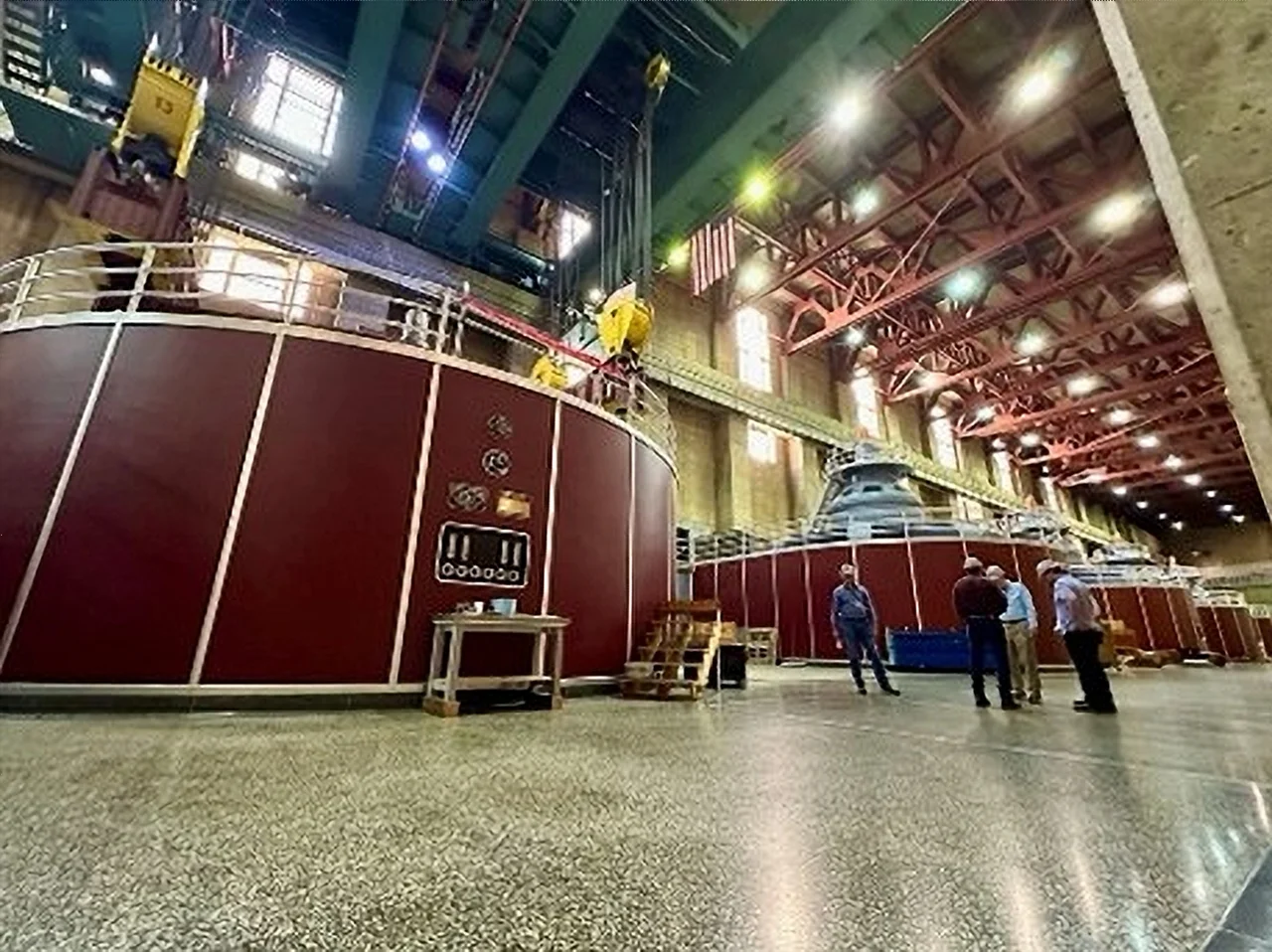

Hoover Dam gets $52 million upgrade
The Bureau of Reclamation announces a $52 million turbine replacement program to protect Hoover Dam's generating capacity against record-low Lake Mead levels and cavitation damage. — Western Water, May 2026

A technically grounded case study of Hoover Dam (1931–1936): how arch-gravity structural design saved 1.5 million cubic yards of concrete, how 582 miles of embedded cooling pipe and a 1,000-ton/day refrigeration plant solved the heat-of-hydration problem in 3.25 million cubic yards of mass concrete, and how 58 of 393 foundation grout holes were left incomplete under schedule pressure — triggering a nine-year secret remediation (1938–1947) not publicly acknowledged for decades.


| Parameter | Value |
|---|---|
| Height | 726.4 ft (221.4 m) |
| Crest length | 1,244 ft (379 m) |
| Base thickness | 660 ft (201 m) |
| Crest thickness | 45 ft (13.7 m) |
| Concrete volume | 3.25 million cu yd (2.49 million m³) |
| Structural steel | 45 million lb (20,400 t) |
| Cooling pipe network | 582 miles (937 km) |
| Refrigeration plant capacity | 1,000 tons/day |
| Penstock diameter | 30 ft (9.1 m) |
| Nameplate generating capacity | 2,080 MW (17 turbine units) |
| Lake Mead storage capacity | 28.5 million acre-ft (35.2 km³) |
| Spillway capacity (combined) | 400,000 cfs (11,328 m³/s) |
| Construction cost | $49 million (1931 dollars) |
| Construction period | 1931–1935 (dedicated September 1935; turbines commissioned 1936) |
The Bureau of Reclamation announces a $52 million turbine replacement program to protect Hoover Dam's generating capacity against record-low Lake Mead levels and cavitation damage. — Western Water, May 2026
Comprehensive engineering reference covering the dam's construction, structural design, foundation grouting, workforce history, and modern operational status.
이 콘텐츠를 둘러싼 관점이나 맥락을 계속 보강해 보세요.